• Welcome to your new Gnomio site

    Now, you are in control!

    Moodle is an open-source Learning Management System (LMS) that provides educators with the tools and features to create and manage online courses. It allows educators to organize course materials, create quizzes and assignments, host discussion forums, and track student progress. Moodle is highly flexible and can be customized to meet the specific needs of different institutions and learning environments.

    Moodle supports both synchronous and asynchronous learning environments, enabling educators to host live webinars, video conferences, and chat sessions, as well as providing a variety of tools that support self-paced learning, including videos, interactive quizzes, and discussion forums. The platform also integrates with other tools and systems, such as Google Apps and plagiarism detection software, to provide a seamless learning experience.

    Moodle is widely used in educational institutions, including universities, K-12 schools, and corporate training programs. It is well-suited to online and blended learning environments and distance education programs. Additionally, Moodle's accessibility features make it a popular choice for learners with disabilities, ensuring that courses are inclusive and accessible to all learners.

    The Moodle community is an active group of users, developers, and educators who contribute to the platform's development and improvement. The community provides support, resources, and documentation for users, as well as a forum for sharing ideas and best practices. Moodle releases regular updates and improvements, ensuring that the platform remains up-to-date with the latest technologies and best practices.

    Links of interest:

    (You can edit or remove this text)

Available courses

Essential skills are transferable abilities that are fundamental to success in all areas of life, including work, education, and community. Key examples include communication (speaking, listening), problem-solvingteamwork, and critical thinking. Other important skills are creativityleadership, and adaptability. 
 
Communication and interpersonal skills
  • Speaking and listening: The ability to clearly express ideas and actively listen to others is crucial for collaboration and understanding.
  • Teamwork: Working effectively with others to achieve a common goal is a consistently in-demand skill.
  • Leadership: Guiding teams, managing projects, and influencing outcomes are key components of leadership.
  • Conflict resolution: The ability to navigate and resolve disagreements constructively is a vital interpersonal skill. 
 
Cognitive and problem-solving skills 
  • Problem-solving: Identifying a problem, generating and evaluating solutions, and implementing them is essential in all aspects of life.
  • Critical thinking: Analyzing information to form a well-reasoned judgment is recognized as a top skill for the 21st century.
  • Creativity: Generating new ideas and solutions is valued across many fields.
  • Decision-making: Analyzing information and making appropriate choices based on that analysis is necessary for all professionals. 
 
Personal and adaptive skills
  • Adaptability: The capacity to adjust to new conditions is critical in a changing world.
  • Emotional intelligence: The ability to understand and manage one's own emotions, as well as those of others, is highly important.
  • Resilience: The capacity to recover from setbacks is arguably one of the most important skills one can have.
  • Time management: The skill of organizing your time effectively to accomplish tasks is essential for productivity. 
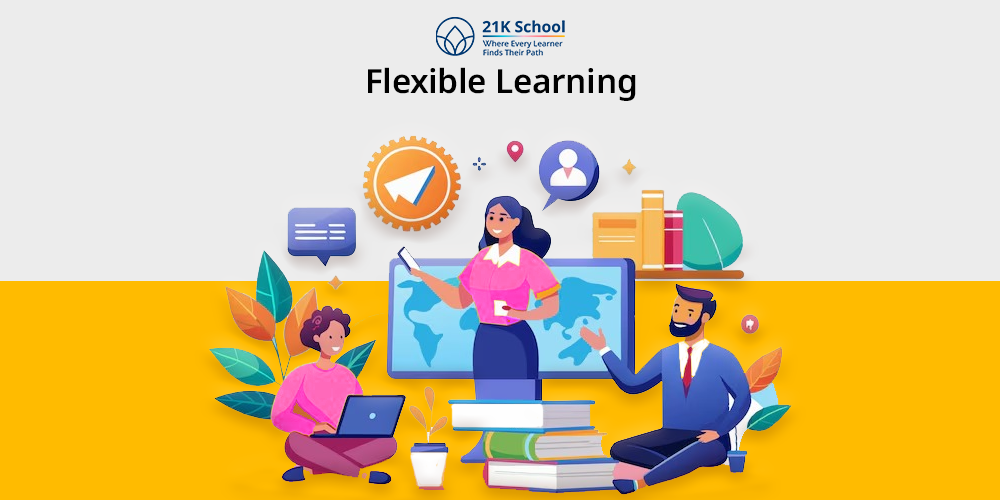
Flexible and blended learning are educational approaches that combine online and face-to-face instruction to create more adaptable and student-centered learning experiencesFlexible learning gives students more control over when, where, and how they learn, often through self-paced online options. Blended learning is a specific type of flexible learning that formally combines online and in-person teaching, creating a hybrid environment with both digital resources and traditional classroom interaction.  
 
Flexible learning
  • Focus: Student autonomy and control over their education. 
     
How it works: Allows students to choose their learning pace, style, and even delivery method (online, blended, or traditional). 
 
Examples:
A self-paced online course that offers tutoring and online resources. 
 
A course where students can choose between online and in-person review sessions. 
 
Blended learning
Focus: 
A structured hybrid environment that combines online and face-to-face learning. 
 
How it works: 
Integrates online materials and activities with traditional in-person instruction, providing both digital flexibility and direct social interaction. 
 
Examples:
Flipped classroom: Students watch lectures online at home, and class time is used for discussions, problem-solving, and hands-on activities. 
 
Web-enhanced courses: Regular in-person classes are supplemented with online activities like quizzes, forums, or simulations. 
 
Flexible labs: Students complete lab work at their own pace in a learning commons area, with support available as needed. 
Education administration is the management of a school or educational system, involving the planning, organizing, and supervising of resources like personnel, finances, and facilities to achieve educational goals. Its primary purpose is to create the necessary conditions for effective teaching and learning. 
 
Key components of education administration:
  • Leadership: Providing leadership to guide the education of students.
  • Resource management: Overseeing human (staff, students, parents) and material (buildings, budget, equipment) resources.
  • Program development: Developing and implementing curricula and assessments.
  • Operations: Managing daily operations, including maintaining order and discipline.
  • Planning and control: Organizing, directing, coordinating, supervising, and evaluating the system to ensure goals are met.